Workplace Systems and Adjustments
Neurodiversity support is not a checklist problem #
Reasonable adjustments are often treated as a single HR decision: someone discloses a diagnosis, a list of possible adjustments is considered, something is agreed, and the organisation moves on.
In reality, good neurodiversity support is more complex than that.
Neurodivergent people do not all need the same things. Two people with the same diagnosis may have completely different strengths, barriers, communication preferences, sensory needs, workload patterns and environmental triggers. A solution that works well for one person may be unhelpful, irrelevant or even counterproductive for someone else.
That is why my work focuses less on giving organisations a static list of answers, and more on helping them build the skills, systems and confidence to find the right answers with the people in front of them.
From one-off adjustments to sustainable systems #
Many workplace adjustments fail not because people do not care, but because the process around them is too thin.
An adjustment may be agreed but not clearly recorded. A manager may be supportive but unsure how to follow it through. A change in workload, line management, team structure or working environment may create new barriers. A support plan may be written once and never reviewed. Or the person may feel responsible for constantly explaining, reminding and justifying their needs.
That creates unnecessary pressure for everyone.
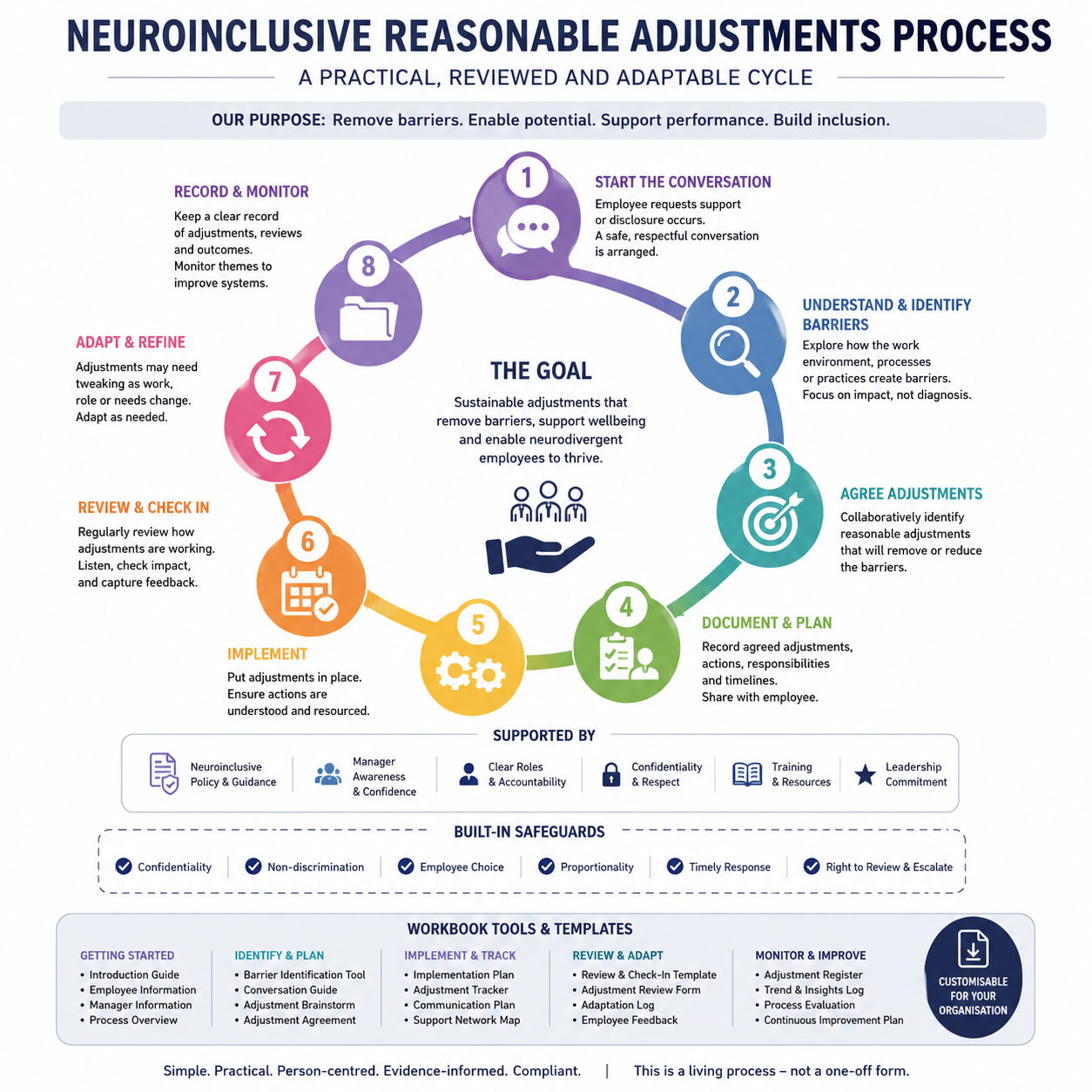
I help organisations move from reactive, informal or inconsistent adjustment processes towards clearer, more sustainable systems. The aim is not bureaucracy for its own sake. The aim is to create practical structures that make support easier to understand, easier to implement and easier to review.
This includes helping organisations think about:
- how barriers are identified;
- how adjustment conversations are held;
- how support is recorded and communicated;
- who is responsible for implementation;
- how adjustments are reviewed;
- how managers are supported;
- how workload, communication and environmental factors affect performance;
- and how support can adapt when people’s work or circumstances change.
Reasonable adjustment planning #
I support organisations, managers and individuals to develop reasonable adjustment plans that are practical, collaborative and grounded in real working contexts.
This is not about producing generic lists of adjustments. It is about understanding the relationship between the person, their role, their environment, their workload, their team systems and the expectations placed on them.
A good adjustment process should help everyone understand what is needed, why it is needed, how it will work in practice, and how it will be reviewed.
This may include support with:
- reasonable adjustment conversations;
- workplace adjustment passports;
- manager guidance;
- review processes;
- workload and communication adjustments;
- task management and prioritisation systems;
- hybrid working considerations;
- sensory and environmental barriers;
- meeting, email and information-processing demands;
- and practical implementation planning.
Supporting managers to have better conversations #
Managers are often expected to support neurodivergent staff without being given the skills, confidence or frameworks to do so well.
Many are worried about saying the wrong thing. Some avoid conversations altogether. Others try to be supportive but become too vague, too informal or too dependent on the individual repeatedly explaining what they need.
My approach helps managers develop the confidence to have clear, respectful and useful conversations about support, performance, workload and barriers.
This is not about turning managers into clinicians. It is about helping them ask better questions, listen more effectively, understand workplace barriers, agree practical next steps and follow through with consistency.
Building capability, not dependency #
A common weakness in neurodiversity consultancy is the reliance on external expertise. An expert arrives, explains neurodivergence, provides a set of recommendations, and leaves. The organisation may feel more informed, but not necessarily more capable.
My approach is different.
I help organisations build their own internal capability. That means developing the skills to listen, reflect, identify barriers, co-create solutions, review what is working and adapt support when things change.
The goal is not for organisations to become dependent on me for every answer. The goal is for managers, teams and systems to become more confident, reflective and responsive.
Workplace systems matter #
Neurodiversity support is often framed as something that sits with the individual. The question becomes: what does this person need to do differently to cope?
I take a wider view.
Workplaces are full of systems that shape people’s ability to function well: communication channels, meeting cultures, deadlines, task management tools, decision-making processes, workload expectations, sensory environments, informal norms and management practices.
When those systems are unclear, inconsistent or overloaded, neurodivergent people often carry a heavier cognitive and emotional burden. They may spend more energy navigating the system than doing the work itself.
Improving workplace systems can therefore benefit everyone, while being particularly important for neurodivergent staff.
This might include clearer prioritisation processes, better meeting structures, more accessible communication, improved task tracking, reduced ambiguity, clearer role expectations, and more consistent review points.
What this support can include #
Workplace Systems and Adjustments support can be offered as a focused piece of work or as part of a wider neurodiversity programme.
Depending on your organisation’s needs, this may include:
- reasonable adjustment planning;
- reviewing existing adjustment processes;
- developing adjustment passports or workbooks;
- manager coaching and guidance;
- training on adjustment conversations;
- stress and workload review processes;
- support with neuroinclusive communication systems;
- team-based reflective practice;
- workshops on barriers and environmental design;
- and practical implementation support.
How I work #
My work is collaborative, evidence-informed and practical.
I do not arrive with a fixed template and assume it will work in every organisation. Instead, I start by understanding your context: what you already do, what has worked, where things get stuck, and what your people need from the process.
From there, I help you develop systems that are realistic, proportionate and sustainable.
The process usually involves listening, identifying barriers, co-creating practical responses, implementing agreed changes, reviewing impact and building internal confidence over time.
Who this is for #
This support is suitable for organisations that want to improve how they support neurodivergent staff, particularly where current processes feel informal, inconsistent, reactive or overly dependent on individual managers.
It may be especially useful if:
- reasonable adjustments are agreed but not consistently implemented;
- managers lack confidence around neurodiversity conversations;
- staff are repeatedly having to explain their needs;
- support plans are not reviewed;
- workload, communication or sensory barriers are affecting performance;
- absence, stress or burnout are becoming concerns;
- or your organisation wants to move beyond awareness training into practical, sustainable change.
The outcome #
The aim is to create workplaces where support is not left to chance.
By developing clearer systems, better conversations and stronger internal capability, organisations can reduce unnecessary barriers, support managers more effectively, and create working environments where neurodivergent people are better able to contribute, participate and thrive.
Neurodiversity support works best when organisations stop searching for universal answers and start building the skills to understand, adapt and respond to the people in front of them.